
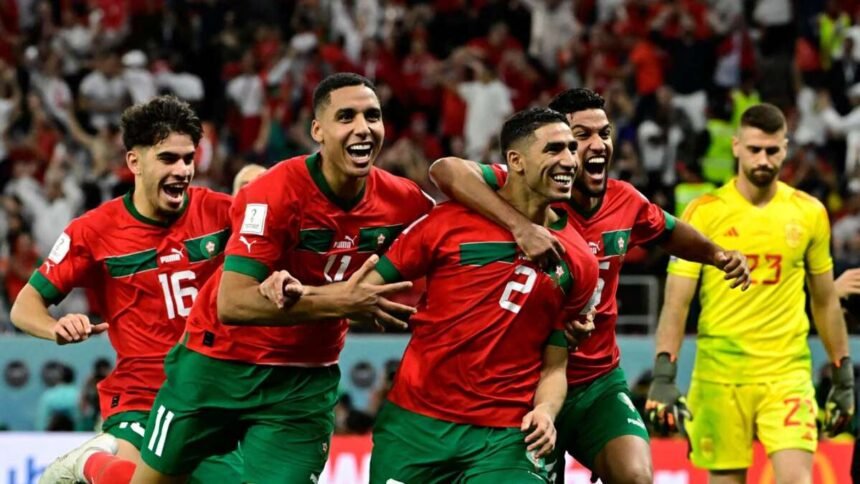
In a commanding performance that has reverberated across the continent and beyond, Morocco has etched its name in football history by becoming the first African country to secure qualification for the 2026 FIFA World Cup — and it did so in emphatic fashion.
The Atlas Lions confirmed their place in the expanded 48-nation tournament — set to be co-hosted by the United States, Canada, and Mexico — with two matches still to spare after a resounding 5-0 victory over Niger in Marrakech.
From the outset, Morocco looked determined. A crucial early sending-off for Niger’s Abdoul-Latif Goumey in the 26th minute swung momentum decisively, and within three minutes, Ismael Saibari broke the deadlock. He would soon add a second, effectively putting the match — and their qualification — beyond doubt before the half-time whistle.
The rout continued after the break, with Ayoub El Kaabi, Hamza Igamane, and Azzedine Ounahi all finding the net to complete one of Morocco’s most dominant displays of the qualifying campaign.
This marks Morocco’s seventh appearance at the global showpiece, extending a proud tradition that has seen the North African side steadily rise in international standing. The Atlas Lions remain the only African team to have reached the semifinals of a FIFA World Cup, a feat they achieved memorably at Qatar 2022.
What makes this qualification particularly noteworthy is not just its timing — securing a World Cup berth with games yet to be played — but also the manner of the performance. Morocco maintained a perfect record throughout the qualifiers, underscoring their consistency and tactical discipline.
As the continent braces for the road to June–July 2026, Morocco’s early qualification sets a benchmark for other African hopefuls. Africa eventually secured nine direct World Cup slots, including high-profile names such as Tunisia, Egypt, Senegal, South Africa, Ivory Coast, and Ghana, in addition to Morocco’s early leap into the global tournament.
For Moroccan fans and African football as a whole, this achievement is more than a statistical milestone. It signals a continuation of the continent’s growing influence on the world stage — with teams not only qualifying consistently but doing so with style, strength, and tactical maturity that command the respect of the global game.
With memories of their Qatar 2022 heroics still fresh, the Atlas Lions now have nearly a year to build toward what could be one of Africa’s most compelling World Cup campaigns yet. As the continent’s first qualifier, Morocco has raised the bar for its regional peers and reaffirmed that African football is not merely participating — it is contending.