
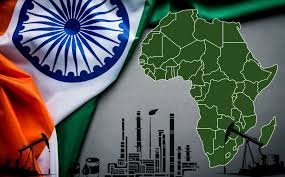
India’s footprint in Africa has evolved from historical ties into a multi‑dimensional engagement encompassing trade, investment, development cooperation and geopolitical collaboration. In recent years, Indian economic and strategic outreach has surged — propelled by mutual opportunity, a shift in global power dynamics, and a deliberate policy of partnership rooted in shared interests rather than traditional aid.
Trade and Investment Growth Signals a New Era
Economic data underscore the depth of this transformation. Bilateral trade between India and African nations has climbed significantly, surpassing USD 100 billion in the 2024‑25 fiscal year, a remarkable increase from about USD 56 billion in 2019‑20. Indian investments in Africa now total around USD 75 billion, positioning New Delhi among the top five investors on the continent with projections to double trade by 2030.
India’s export portfolio to Africa spans machinery, transport equipment, pharmaceuticals, textiles and technology — sectors that not only meet demand but also promote industrial linkages and employment across regional value chains. Meanwhile, Africa remains a key source of critical raw materials and energy resources, vital for India’s manufacturing and energy transition strategies.
Beyond Infrastructure: A Market‑Driven Investment Model
Unlike China’s large‑scale infrastructure‑ and debt‑driven investment model, India’s approach in many African markets emphasizes market‑oriented, partnership‑based investment that builds on local commercial ecosystems. Firms such as Bharti Airtel have established significant operations in Nigeria and other regions, leveraging technology and service delivery to foster long‑term economic ties. Analysts note that while Chinese state‑led projects may be larger in scale, India’s emphasis on healthcare, IT infrastructure, manufacturing and skills transfer could yield more enduring development outcomes.
Capacity Building and Development Cooperation
India’s engagement is not confined to commerce. Through concessional lines of credit exceeding USD 12 billion and capacity‑building programs like the Indian Technical and Economic Cooperation (ITEC), India supports infrastructure, water supply, vocational training and education across more than 40 African countries. Initiatives such as the International Solar Alliance and scholarship programs underline a people‑centric dimension that goes beyond economic statistics.
Strategic and Geopolitical Synergies
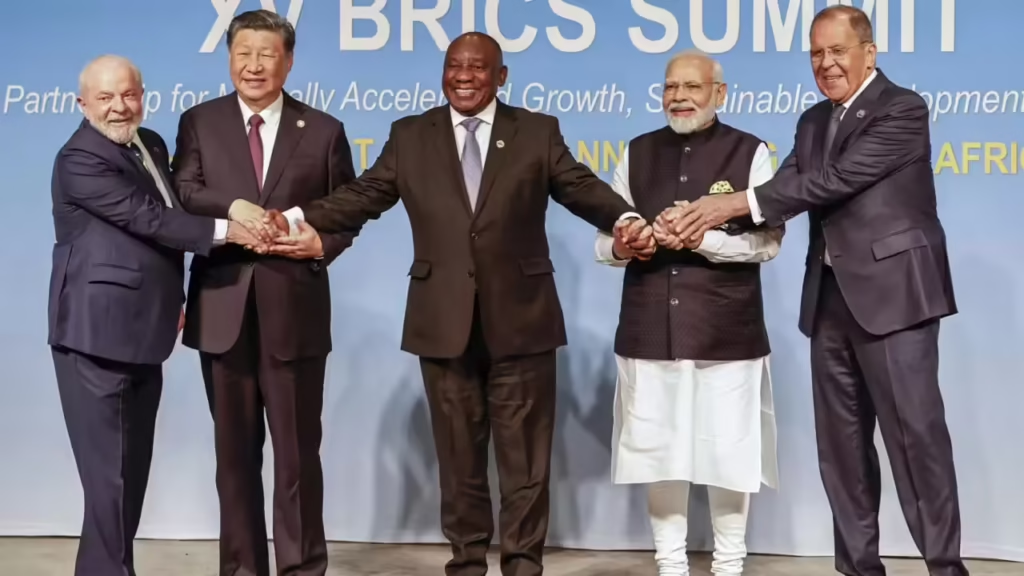
Strategically, India and Africa share convergent interests in global governance. India’s successful advocacy for African Union permanent membership in the G20 and joint positions in international forums reflect a partnership that extends into diplomatic influence. Security cooperation — from maritime anti‑piracy operations in the Indian Ocean to joint naval exercises with African partners — also augments India’s role as a security partner, though it continues to navigate competing influences in a region where China’s presence remains substantial.
Challenges and the Road Ahead
Despite significant strides, structural and geopolitical challenges persist. India‑Africa trade still trails China’s total trade volume with the continent, and African infrastructure deficits — compounded by political instability in parts of the Sahel and Horn of Africa — present obstacles for deeper foreign direct investment. Corruption concerns and tensions over workforce localization illustrate the complex landscape Indian businesses must navigate.
Conclusion
India’s strategy in Africa is increasingly multifaceted: a blend of commercial pragmatism, development cooperation, strategic alignment and cultural affinity. While it may not yet rival China in sheer scale, India’s model — prioritizing market integration, human capital development and shared prosperity — positions it as a sustainable partner attuned to Africa’s own developmental aspirations. As both regions look toward the next decade, the strength and resilience of this partnership will likely hinge on deeper economic integration, institutional cooperation, and Africa’s evolving role in the global economic order.