

GABORONE — Botswana, long hailed as Africa’s jewel of economic success, is confronting a stark inflection point as its diamond-dependent economy slides into contraction this year. Government forecasts released in December now show that the country’s gross domestic product (GDP) is expected to shrink by nearly 1 percent in 2025, reversing the optimistic growth projections presented earlier in the year.
The sharp downgrade stems from a prolonged downturn in the global diamond market, which remains Botswana’s dominant economic engine. Diamonds traditionally account for roughly one-third of government revenues and an overwhelming share of foreign exchange receipts. As global demand weakens and prices falter, the ripple effects are felt across public finances, business confidence and employment.
From Growth Hope to Contraction Reality
In February 2025, Botswana’s finance ministry had forecast a 3.3 percent expansion for the year, driven by expectations of a rebound in diamond exports and stronger performance in ancillary sectors. That outlook, however, has been overtaken by deteriorating global conditions and sustained pressure on rough diamond prices.
By mid-year it became clear that the anticipated recovery had not materialised. Instead, diamond trading and mining revenues continued to decline, forcing officials to recalibrate their economic expectations. The new forecast of a 0.9 percent contraction represents not just a statistical adjustment but a symbolic shift in the fortunes of an economy long synonymous with stability and growth.
Diamond Dependence Under the Microscope
Botswana’s reliance on diamond revenues has long been lauded for facilitating investments in infrastructure, health and education. But that very dependence now highlights the vulnerability of a mono-commodity model in a rapidly changing global market.
Industry analysts point to several structural headwinds facing the diamond sector, including shifting consumer preferences, increased popularity of lab-grown alternatives, and uneven global demand. These factors have eroded the traditional market for natural stones, leaving Botswana exposed to forces beyond its control.
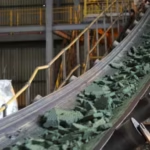
The contraction in diamond sales has also been accompanied by notable production cuts. Major mining operations have scaled back output in response to weaker market conditions, constraining foreign exchange inflows and placing additional pressure on the national balance sheet.
Government Response and Broader Risks
Faced with deteriorating revenues, policymakers are stepping up talks on diversification strategies aimed at reducing broader economic risk. Efforts to expand mining beyond diamonds—such as granting new licences for copper exploration in the Kalahari Belt—signal a growing recognition that Botswana must build resilience beyond its traditional cash cow.
Nonetheless, the immediate fiscal outlook remains challenging. Lower diamond receipts constrain government spending at a time when social needs are rising, and external pressures are mounting. Fiscal consolidation measures and economic transformation programmes are under discussion, but their impact will only materialise over the medium term.
Looking Ahead
As 2025 unfolds, Botswana’s economic trajectory will be shaped by both external market developments and the pace of structural reform. For a country that has long been a model of economic prudence and commodity-led growth, the current contraction underscores the perils of over-reliance on a single industry and the urgent imperative of diversification.
To navigate this turbulent period, Botswana faces a dual challenge: stabilising near-term economic conditions while laying the groundwork for a broader, more resilient growth engine that can withstand the ebb and flow of global demand.