
CONAKRY — A major legal confrontation has erupted in West Africa’s mining heartland as Axis International Ltd, a United Arab Emirates–based bauxite producer, has launched a $28.9 billion arbitration claim against the Republic of Guinea at the World Bank’s International Centre for Settlement of Investment Disputes (ICSID). The move follows the Guinean government’s controversial decision earlier this year to revoke the company’s mining permit for its bauxite operations in the Boffa region, a mine Axis says was fully operational and a significant contributor to the national economy.
The dispute underscores mounting friction between foreign investors and resource-rich African states increasingly determined to assert control over strategic sectors and extract greater economic benefit from their natural endowments. Guinea’s bauxite reserves rank among the world’s largest, and policies shaping how they are exploited will reverberate through global aluminium supply chains.
From Licence Revocation to Multibillion-Dollar Claim
Axis International, which owns 85 per cent of Axis Minerals Resources SA, had its permit rescinded by Guinea’s authorities in May 2025 as part of a broader recalibration of mining licences across the country. Guinea’s leadership, under President Mamady Doumbouya, has stressed a commitment to strengthen oversight of the mining sector, improve revenue capture and encourage local processing of raw ores. Critics of the permit withdrawals, however, argue that the abrupt policy shift risks destabilising investor confidence.
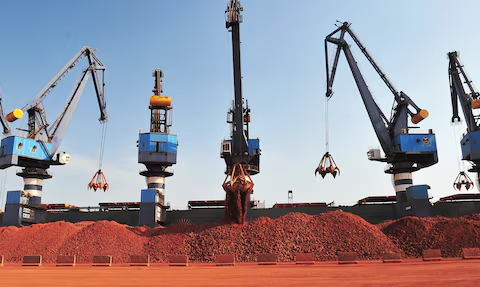
In its ICSID filing, Axis alleges that Guinea’s justification — that the mine was under-utilised or inactive — is factually incorrect. The company notes that the operation produced approximately 18 million tonnes of bauxite in 2024, making it one of the nation’s largest producers and supporting thousands of jobs in the surrounding communities. Based on proven reserves exceeding 800 million tonnes, Axis asserts that Guinea’s actions breached investment protections under both the Guinea–UAE bilateral investment treaty and Guinea’s own investment code.
High Stakes for Conakry and Its Mining Policy
Guinea’s government has not publicly detailed its response to the arbitration filing. Yet officials have in other contexts defended the revocation of licences as necessary to ensure that mining activities deliver tangible benefits — including increased domestic value addition, higher royalties and stricter compliance with contractual obligations. Observers note that Axis’s claim is one of the most substantial ever lodged against an African state, highlighting the potential financial risk associated with contentious resource-sector reforms.
Should Guinea be found liable and ordered to pay all or part of the $28.9 billion, the financial implications are significant. Such an award could challenge Conakry’s fiscal planning, affect its access to international capital markets and temper the appetite of other foreign investors considering opportunities in the country’s rich mineral fields. Axis has warned that failure to resolve the dispute amicably could jeopardise Guinea’s relationships with multilateral lenders and donors.
Broader Implications for African Resource Nationalism
The Axis case arrives amid a broader continental trend in which governments are renegotiating the terms of extractive industry engagement. African states are increasingly emphasising resource sovereignty, local beneficiation and industrialisation, aiming to shift away from mere commodity extraction toward value-added economic activity. However, this shift often puts them at odds with investors seeking regulatory consistency and legal protections.
For Guinea, the outcome of the arbitration will be closely watched — not just for its direct impact on the nation’s finances, but for its resonance across Africa’s resource policy debates. Striking a balance between attracting investment and securing equitable development outcomes remains a central challenge for resource-rich economies navigating the complexities of 21st-century global markets.
The World Bank tribunal’s deliberations, which could extend over several years, will determine whether Axis’s bold legal gambit succeeds and chart new precedents for investor–state dispute resolution in mining jurisdictions across the continent.