
Nairobi — Kenyan President William Ruto has publicly welcomed a proposed one‑year extension of the African Growth and Opportunity Act (AGOA), a cornerstone trade framework that has underpinned U.S.–Africa commerce for a quarter of a century. The announcement has sparked optimism among business leaders and exporters across the continent, even as analysts caution that deeper reforms are needed to fully unlock Africa’s export potential.
The extension, first signaled by officials in Washington, D.C., comes after months of uncertainty following AGOA’s scheduled expiration on September 30, 2025. President Ruto described the development as a critical step toward preserving market access for African manufacturers and agricultural exporters, particularly in key sectors such as textiles, leather goods, processed foods, chemicals and ICT services.
AGOA: More than a Trade Pact
Since its inception in 2000, AGOA has permitted eligible African countries to export thousands of products to the United States duty‑free, creating jobs and stimulating industrialisation across the continent. Kenya — one of the act’s foremost beneficiaries — has leveraged AGOA to expand its apparel and horticultural exports, scaling production for U.S. markets and attracting investment into domestic value‑chains.
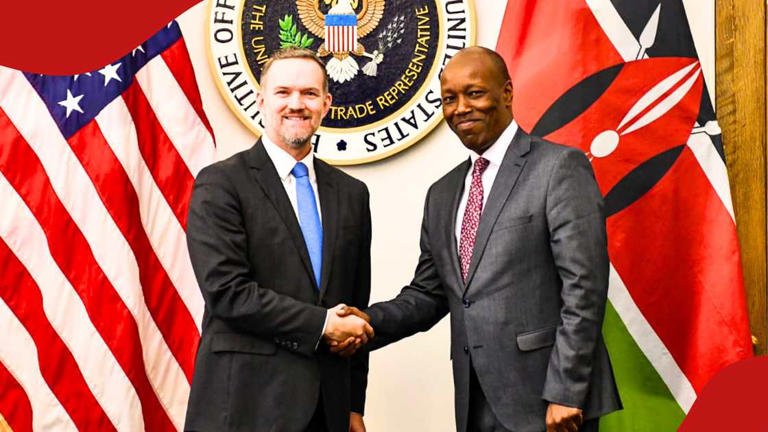
“AGOA has been transformative for Kenyan industry,” President Ruto said in Washington, where he engaged with U.S. Trade Representative Jamieson Greer and business delegations. “This extension safeguards the progress we’ve made and gives our exporters the certainty they need to plan, invest and compete globally.”
The extension also offers a window for strategic recalibration of the pact itself. Trade experts and governments alike have suggested that, beyond mere renewal, AGOA should be updated to reflect 21st‑century supply chains, digital trade, and broader regional integration under the African Continental Free Trade Area (AfCFTA).
Economic Impact Across the Continent
Kenya’s reaction mirrors sentiments expressed by other African capitals, where AGOA access has been credited with enabling industrial hubs to emerge from Lagos to Accra and Dakar to Addis Ababa. In Kenya alone, the textile and apparel sectors have seen significant expansion, bolstered by preferential access that has helped local firms compete with producers from Asia and Latin America.
However, many businesses remain cautious. Some manufacturers argue that a one‑year extension, while positive in the short term, leaves uncertainty in place for long‑term capital investment decisions. Investors typically seek multi‑year policy horizons before committing to large‑scale factories and equipment — a reality that could temper hiring and expansion plans in the absence of longer AGOA guarantees.
Toward AGOA 2.0?
Analysts have increasingly called for a rebranded AGOA — sometimes dubbed “AGOA 2.0” — that addresses contemporary trade dynamics, strengthens rules of origin, enhances supply‑chain resilience, and dovetails with AfCFTA’s broader ambition to create a seamless African market of 1.3 billion consumers. Such reforms could amplify the pact’s developmental impact and help African economies graduate into higher‑value exports.
For now, Kenyan exporters are preparing to capitalise on the extended access. Agricultural producers, manufacturers and service providers are planning expanded shipments to the U.S. over the coming year, even as governments and trade associations advocate for a long‑term framework that delivers certainty beyond 2026.
Looking Forward
As discussions continue in Washington and across African capitals, one message has emerged with clarity: trade partnerships matter — and they must evolve. The AGOA extension represents more than a policy tweak; it signals ongoing U.S. interest in African economic growth and underscores the interdependence of global markets. Whether this one‑year reprieve becomes a springboard for deeper reform remains a central question for policymakers and private sector leaders alike.