

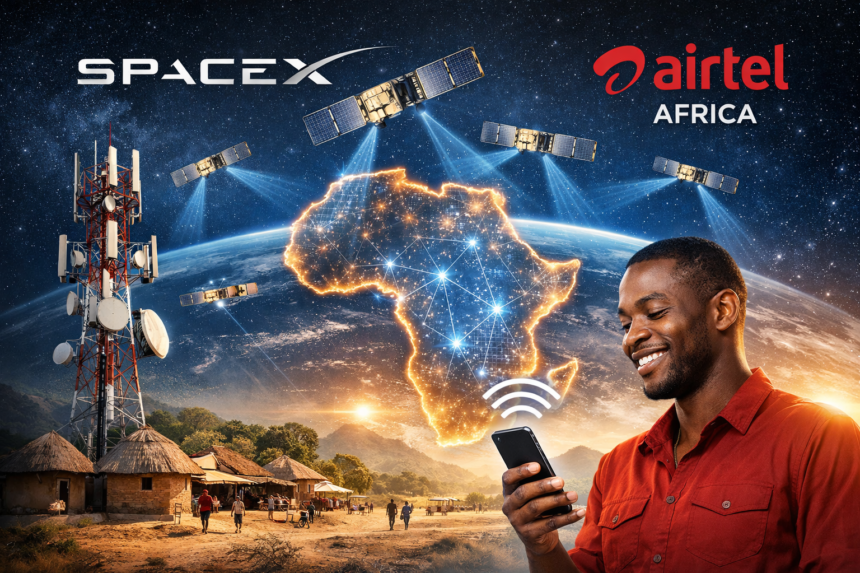
In a bold new push to bridge Africa’s persistent digital divide, Airtel Africa has entered a strategic partnership with SpaceX’s Starlink to deploy satellite-based mobile connectivity across its pan-continental footprint. The initiative promises to extend reliable network access to millions of people in areas where traditional terrestrial coverage has long been out of reach.
Under the deal, Airtel Africa will become the first mobile network operator on the continent to offer Starlink’s Direct-to-Cell satellite service, a next-generation connectivity solution that enables standard smartphones to link directly to satellites without any special hardware or additional equipment. The service is slated to begin rolling out in 2026, subject to local regulatory approvals in each of Airtel’s 14 markets.
Reimagining Connectivity Without Borders
The new satellite-to-mobile service is designed to provide essential network access — starting with messaging and selected app data — to users residing in remote and underserved regions where cellular towers and fibre networks are not economically viable or physically feasible to deploy. This marks a major evolution in how connectivity can be delivered across vast swathes of the continent.
At the heart of the partnership is Starlink’s Direct-to-Cell technology, powered by an expanding constellation of around 650 low-Earth-orbit satellites. These satellites can function like space-based cell towers, delivering network coverage directly to compatible devices. Over time, the service is expected to scale up to include broadband-level speeds, potentially up to 20 times faster than earlier satellite-to-mobile systems, closing one of Africa’s most stubborn digital gaps.
Connectivity With Deep Social Impact
For many communities across Africa — from sparsely populated rural villages to regions with challenging topography — the partnership represents more than just better reception. It unlocks access to education, healthcare, financial services and economic opportunity by enabling reliable communication where none existed before. Analysts say this could be transformative for underserved populations that have long been disconnected from digital networks.
Airtel Africa’s 174 million subscribers stand to benefit directly from this initiative, which complements existing terrestrial infrastructure rather than replacing it. The model also reduces barriers to deployment since customers will not need special equipment to access the satellite service — a smartphone compatible with the network will suffice.
Strategic Push in a Competitive Market
The move places Airtel Africa at the forefront of a growing wave of satellite-assisted connectivity solutions in emerging markets. While traditional mobile operators have invested heavily in terrestrial networks, the cost and logistical burden of expanding into low-density areas have often left gaps. The Starlink partnership offers a competitive differentiator by bringing coverage to places where tower construction remains impractical.
Airtel Africa’s CEO described the collaboration as a key milestone in the company’s digital inclusion agenda, emphasising that satellite technology can extend network reach even in the most challenging environments. Starlink representatives have echoed this ambition, highlighting the potential for life-changing connectivity for people previously living off the grid.
Looking Ahead
As the 2026 rollout approaches, industry watchers will be watching closely to see how regulatory landscapes in different African markets evolve and how quickly users adopt the new service. If successful, this partnership could redefine connectivity norms on the continent — turning once isolated regions into digitally linked communities and setting a new standard for how large-scale satellite services can support socioeconomic development across Africa.