

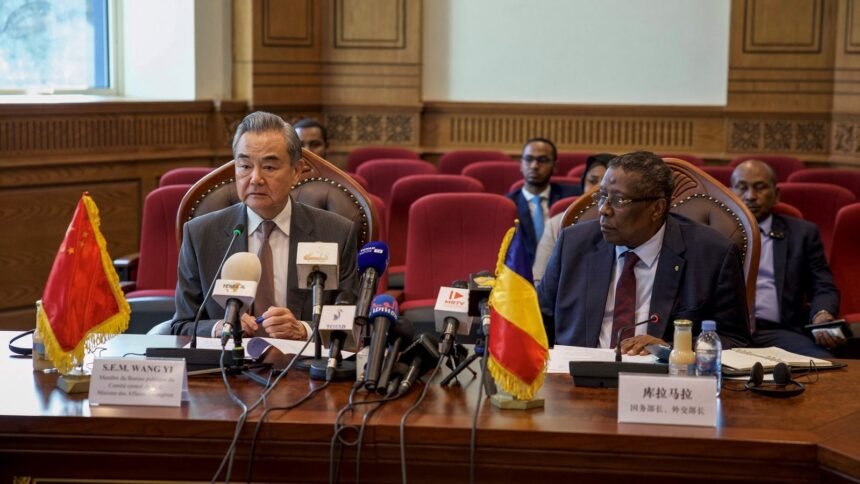
ADDIS ABABA / BEIJING — January 8, 2026 — China’s top diplomat, Foreign Minister Wang Yi, has kicked off his annual New Year tour of Africa with a clear strategic agenda: cement geopolitical influence, expand trade access and lock in economic partnerships across key regions of the continent. The visit, spanning Ethiopia, Somalia, Tanzania and Lesotho, underscores Beijing’s deepening focus on Africa at a time of intensifying global competition for influence.
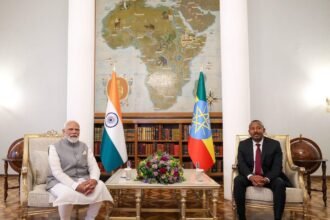
For the 36th consecutive year, Africa remains the destination for China’s first major foreign trip, reinforcing its longstanding prioritisation of the continent within Beijing’s global diplomacy framework. Ethiopia — Africa’s fastest‑growing large economy — served as the tour’s opening stop, where Wang met with Prime Minister Abiy Ahmed to reaffirm cooperation on infrastructure, trade, energy and emerging fields such as digital technology and green development.
Strategic Navigation Through the Horn and Beyond
Perhaps the most geopolitically symbolic leg of the trip is Wang’s stop in Somalia — the first visit by a Chinese foreign minister in decades. Beijing’s engagement comes against the backdrop of rising tensions in the Horn of Africa, including Israel’s recent recognition of Somaliland, the breakaway region whose status remains contested. China has reiterated its support for Somalia’s sovereignty and emphasised the strategic importance of the Gulf of Aden, a crucial gateway for Chinese trade transiting through the Red Sea and Suez Canal en route to Europe.
In Tanzania, Wang’s delegation is placing significant emphasis on resource and infrastructure diplomacy. Chinese firms are playing a leading role in refurbishing the Tazara Railway, a historic transportation corridor that links Tanzania to Zambia’s copper‑rich hinterland. The railway is increasingly viewed as part of China’s broader plan to secure access to Africa’s minerals and offer infrastructure alternatives to Western‑backed projects such as the Lobito Corridor linking central Africa to Atlantic ports.
Free Trade Messaging and Economic Opportunity
The final leg of the tour takes Wang to Lesotho, a small southern African economy with close ties to China. Beijing’s messaging here centres on its role as a champion of free trade for developing nations. Last year, China fulfilled a pledge made at the 2024 China‑Africa Cooperation (FOCAC) Summit by offering tariff‑free access to its vast domestic market for the poorest countries, positioning itself as a counterbalance to global trade barriers imposed by other powers. Lesotho — which experienced significant U.S. tariffs under past American policies — stands to benefit directly from this initiative.
Beyond Infrastructure: A Broader Vision
Analysts note that China’s engagement in Africa has been evolving beyond its traditional infrastructure footprint. As Wang’s tour progresses, there will be keen interest in how Beijing’s diplomatic rhetoric translates into concrete collaborations in sectors such as green energy, technological innovation and people‑to‑people exchanges. This dimension aligns with recent declarations by Chinese officials designating 2026 as the China‑Africa Year of People‑to‑People Exchanges, aimed at deepening cultural and educational ties between the regions.
For many African leaders, Wang’s itinerary offers an opportunity not just to secure foreign direct investment but also to negotiate terms that align with national development priorities, including industrialisation and diversification away from raw materials export dependence. As global powers vie for influence on the continent, China’s high‑profile diplomacy — anchored this year in strategic trade routes, infrastructure corridors and economic inclusivity — signals that Africa will remain firmly on Beijing’s geopolitical and economic map in 2026 and beyond.








Wang Yi’s tour focusing on trade access and partnerships seems like a significant move for both China and Africa. I found some interesting background on geopolitical strategies in the region at https://tinyfun.io/game/hollow-guesser, which helped put this visit in context.