
As the global economic landscape slows under tightening monetary conditions and geopolitical uncertainties, Africa stands out as a hub of rapid economic expansion in 2026. A mix of natural resource rebounds, strategic reforms and rising investment flows is positioning several African nations among the world’s fastest-growing economies.
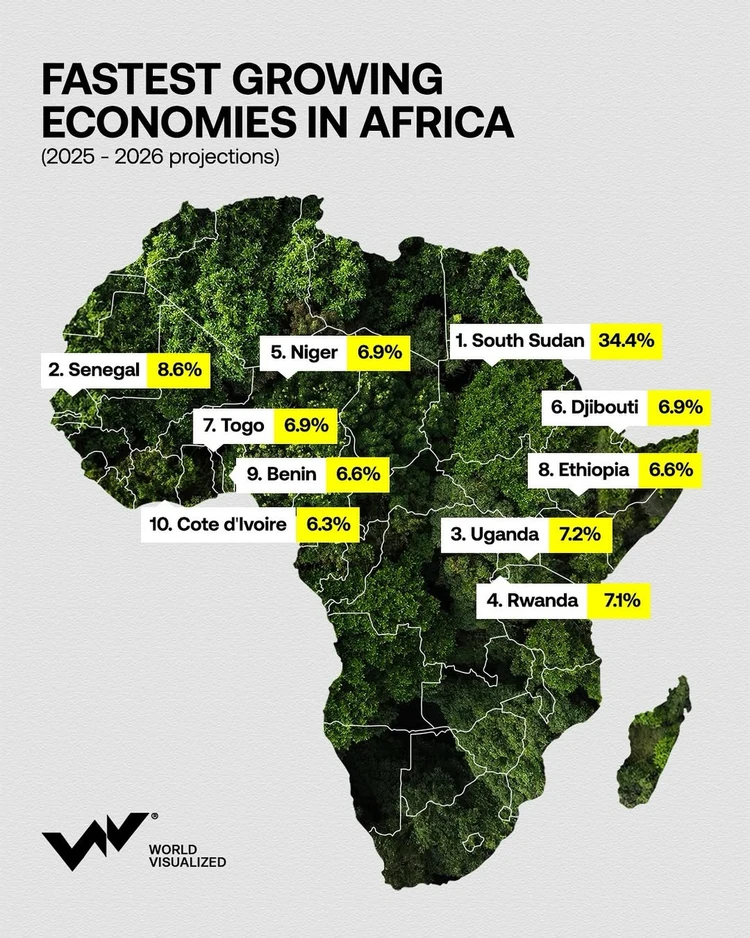
- 1. South Sudan — ~34.4% Growth
- 2. Senegal — ~8.6% Growth
- 3. Uganda — ~7.2% Growth
- 4. Rwanda — ~7.1% Growth
- 5. Niger — ~6.9% Growth
- 6. Togo — ~6.9% Growth
- 7. Djibouti — ~6.9% Growth
- 8. Ethiopia — ~6.6% Growth
- 9. Benin — ~6.6% Growth
- 10. Côte d’Ivoire — ~6.3% Growth
- What This Means for Africa’s Economic Outlook
According to analysts and recent growth forecasts, the following countries are expected to lead the continent in real GDP growth in 2026.
1. South Sudan — ~34.4% Growth
South Sudan is forecast to dominate Africa’s growth rankings in 2026, with GDP expected to expand at approximately 34.4 percent, driven largely by the recovery of oil production and renewed stability that is unlocking long-dormant economic capacities. This dramatic pace reflects a rebound from a low base and significant gains in output and exports.
2. Senegal — ~8.6% Growth
Senegal’s economy is projected to grow by around 8.6 percent, reflecting strong performance in its oil and gas sector — especially with new offshore production coming online — alongside continued investment in infrastructure and agriculture.
3. Uganda — ~7.2% Growth
Economists see Uganda expanding by roughly 7.2 percent in 2026. Growth is underpinned by infrastructure development and progress toward commercial oil output, with improving transport corridors boosting trade and productivity.
4. Rwanda — ~7.1% Growth
Rwanda is expected to sustain robust momentum with approximately 7.1 percent growth. Key drivers include investment in tourism, services, technology and ongoing public infrastructure programmes that continue to strengthen its economic fundamentals.
5. Niger — ~6.9% Growth
Niger’s GDP could expand around 6.9 percent in 2026. Its growth story is tied to increasing mining and hydrocarbon production, alongside rising agricultural output and infrastructure projects facilitating regional connectivity.
6. Togo — ~6.9% Growth
Togo is also projected to grow at around 6.9 percent, with logistics and port services playing a central role in its expansion. Its strategic position in West African trade routes continues to draw investment into transport and industrial sectors.
7. Djibouti — ~6.9% Growth
Djibouti’s growth outlook for 2026 is similar, at an expected 6.9 percent, driven by its geostrategic location. The country remains a critical trade and logistics hub, benefiting from expanding port capacity and services tied to regional commerce.
8. Ethiopia — ~6.6% Growth
Ethiopia’s economy is forecast to grow about 6.6 percent as it continues to develop industrial parks, expand manufacturing exports and scale infrastructure projects. Reconciliation and policy reforms have helped underpin investor confidence.
9. Benin — ~6.6% Growth
Benin is projected to register around 6.6 percent growth. This performance is anchored in trade liberalisation, regional integration efforts and sustained public investment aimed at boosting productivity and creating jobs.
10. Côte d’Ivoire — ~6.3% Growth
Côte d’Ivoire rounds out the top 10 with an expected 6.3 percent expansion, reflecting strong output in agriculture, capital investment in infrastructure and a stable environment that continues to attract foreign direct investment.
What This Means for Africa’s Economic Outlook
These projected growth rates illustrate a broad narrative: while global economic growth is projected to soften, a cluster of African economies is set to outperform many of their peers worldwide. Growth in these nations is being driven by a balanced mix of commodity exports, infrastructure spending, and structural reforms that promote private investment and regional trade.
However, this growth is not uniform — smaller economies, often with low bases, dominate the fastest-growing list, and sustained expansion will depend on political stability, capital flows, and continued structural improvements.
As 2026 approaches, investors, policymakers and development partners will be watching closely to see whether these optimistic forecasts translate into tangible gains in employment, productivity and living standards across the continent.